

NEW POLL SHOWS OVERWHELMING CONCERNS OVER MISUSE OF AI TO SEXUALIZE WOMEN & CHILDREN, INFLUENCE ELECTIONS
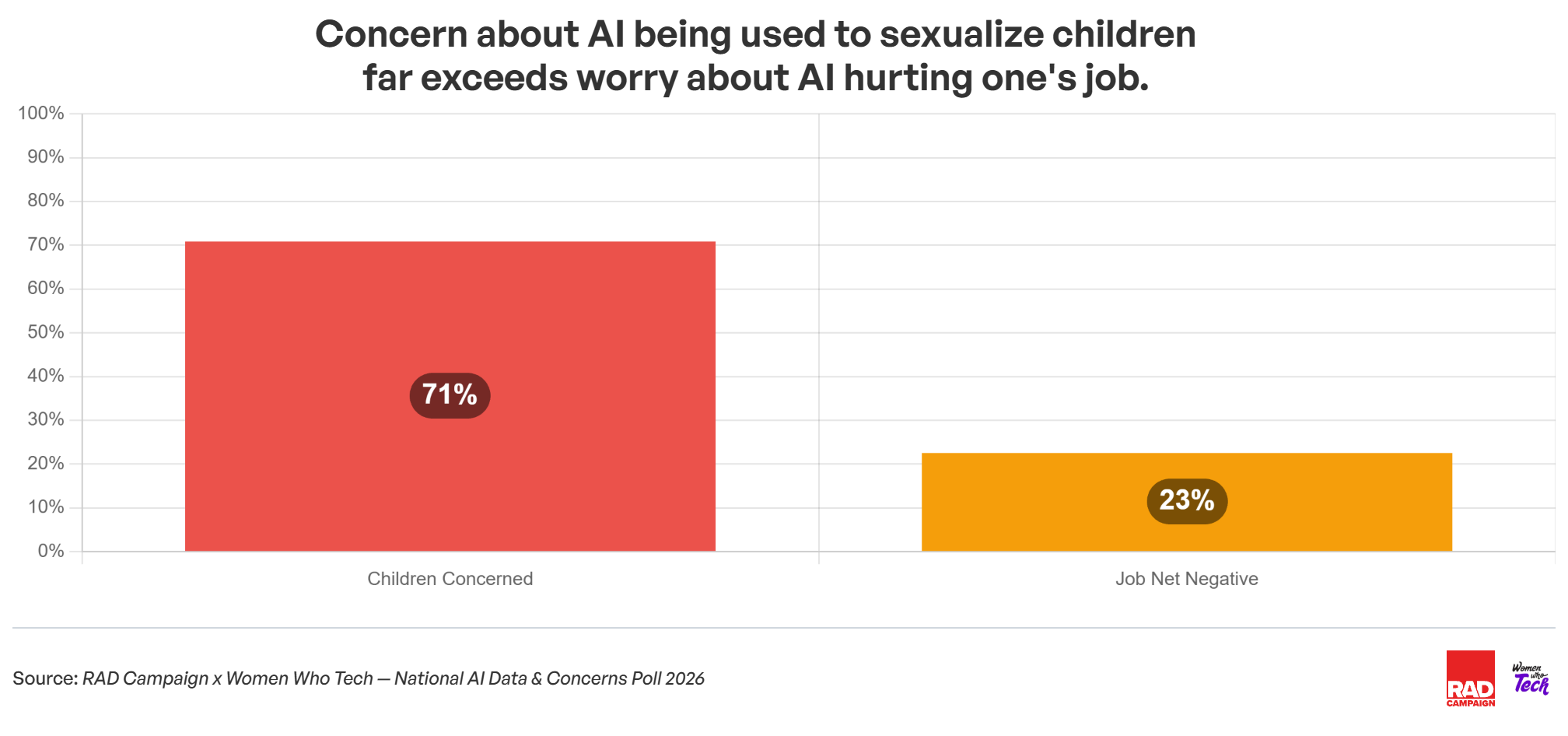
Americans are more concerned about AI being used to sexualize women and children than they are about AI taking their jobs.
Nationwide poll is the first to quantify concerns about AI-generated sexual imagery of women and fills a data gap on concerns over AI sexualization of children
The poll data shows the American public strongly favors guardrails around how artificial intelligence is used, especially when it comes to the sexual exploitation of children and women, as well as politics and elections. The findings come as two bills addressing AI-generated sexual imagery — the DEFIANCE Act, which would let deepfake victims sue, and the ENFORCE Act, which would let prosecutors charge AI-generated child sexual abuse material like any other — sit in the House after passing the Senate unanimously. Congress has enacted no federal legislation addressing AI deepfakes in elections. On all these issues, states have had to step in to protect their constituents even as the White House has attempted to ban state regulations of AI.
"The poll clearly shows that policymakers and Big Tech companies are lagging far behind their own constituents and customers on this issue,” said Allyson Kapin, Founder of Women Who Tech and Rad Campaign. “Voters may disagree about whether AI will benefit them personally, but there's a clear bipartisan majority for safeguards against sexual deepfakes of women and children and for guardrails on politicians' use of AI. Victims have waited long enough, and it's time to pass legislation protecting us from the harms of AI.”
According to poll results, Americans feel that Big Tech has not done enough to curb misinformation on social platforms. About half of all social media users associate the major platforms with increased misinformation or disinformation: 51% on X (formerly Twitter) say it has become “more” or “a lot more” common, with similar numbers for Instagram (48%), TikTok (48%), and Facebook (47%).
One of the strongest areas of concern is the use of AI to create sexual content targeting women and children: 71% register some or high concern about AI deepfakes that sexualize children, and 67% have some or high concern about AI being used to create sexual imagery of women.
The poll was conducted June 13-18, 2026, and comes in the wake of the enormous Grok sexual deepfake scandal, in which X users flooded the platform with AI-generated sexual imagery, mostly of women and children.
Deepfakes are widely recognized as a form of sexual harassment or assault. While there is broad public support and backing from celebrities and advocates such as Paris Hilton, federal efforts to address the issue have had limited impact. The TAKE IT DOWN Act took effect on May 19, 2026, making it too early to assess its effectiveness.
This poll also captured results on political engagement on social media, levels of optimism about AI, frequency of personal AI usage by demographic, and levels of optimism and pessimism about how AI will affect people’s jobs, companies and the economy.
Americans also widely reject the use of AI in elections, politics, and government.
Election-related disinformation generates especially intense concern: About half of respondents, 49%, are “very concerned” about AI spreading disinformation ahead of the midterm elections in November, and 73% indicated some level of concern.
And 81% favor either requiring disclosure of AI-generated content (42%) or prohibiting its use on official government accounts (39%). Only 19% believe politicians should be free to use AI-generated content on social media without restriction.
The poll provides extensive demographic breakouts. For example, college-educated respondents (50%) and registered voters (47%) show higher concerns about AI misuse in politics than those who are not college educated (41%) or not registered to vote (35%).
Social media users report seeing about the same amount of or more politics-related misinformation and disinformation on platforms than a few years ago: 93% of users say they see the same amount or more on Instagram; those numbers are 91% for Facebook, 90% for YouTube, 88% for X, and 87% for TikTok.
Poll results, data visualizations and methodology here.
Allyson Kapin
Women Who Tech and Rad Campaign
Allyson@womenwhotech.org
Legal Disclaimer:
EIN Presswire provides this news content "as is" without warranty of any kind. We do not accept any responsibility or liability for the accuracy, content, images, videos, licenses, completeness, legality, or reliability of the information contained in this article. If you have any complaints or copyright issues related to this article, kindly contact the author above.
